Turn agentic AI, AI automation into operator-ready workflows, course assets, and business output.
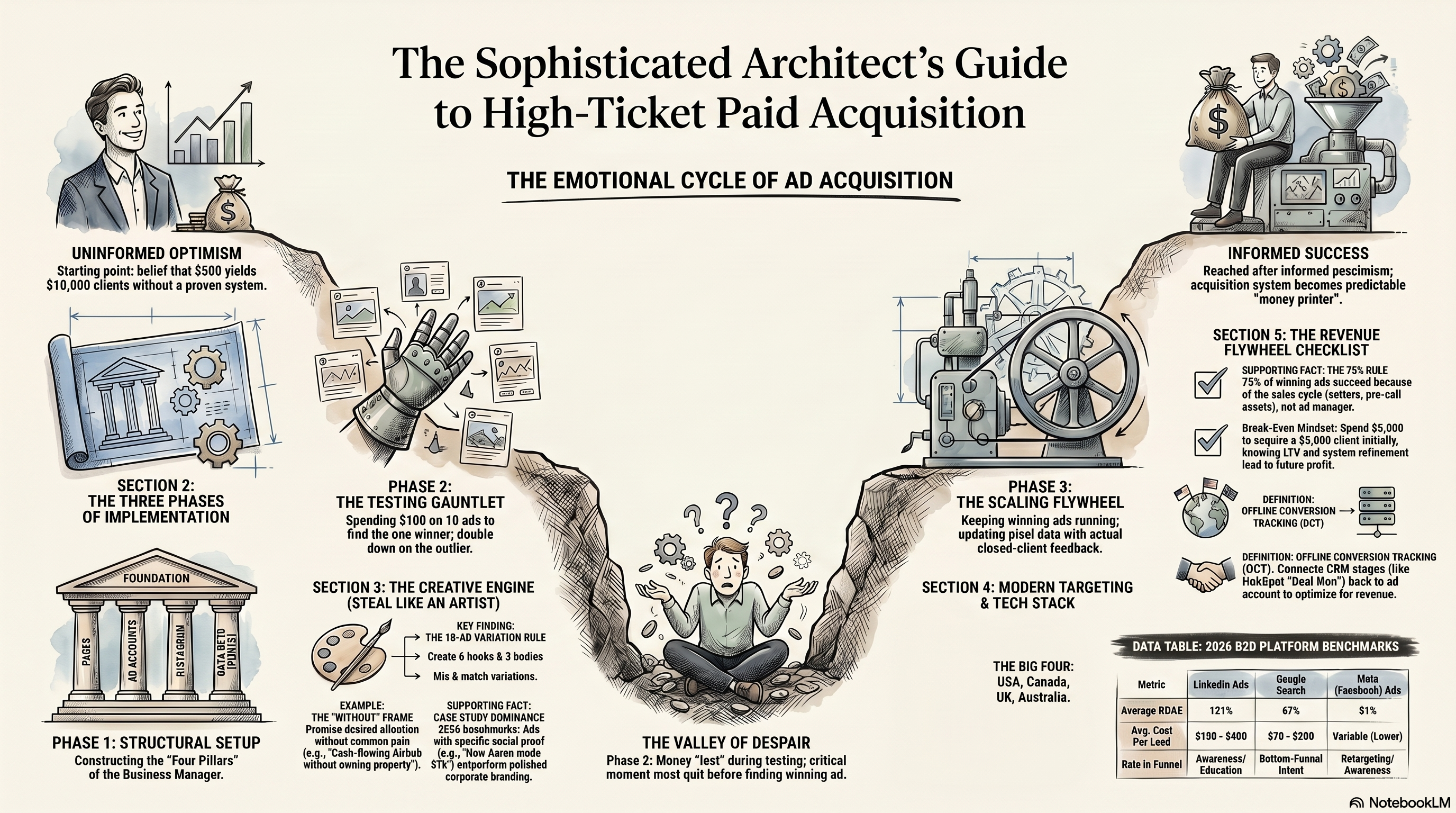
Get a free inside look at “Paid Acquisition & Performance Ad Systems” — the module infographic and the video overview.
By the numbers
Move from scattered lessons into repeatable workflows, decision checkpoints, and practical learner assets.
Every module maps to a concrete operator workflow, learner lab, and reusable asset.
Course markdown, trainer resources, student guides, and lead magnets are distilled into buyer-ready messaging.
Use the checklists, guides, and templates to ship work during the course instead of waiting until after it.
Deloitte's State of AI in the Enterprise 2026 found 66% of organizations have already achieved productivity and efficiency gains and 40% reported cost reductions from their AI initiatives.
Hybrid RPA + agentic AI automation stacks achieve roughly 95% process coverage and an average 276% ROI, per Aptimeta's 2025-2026 automation analysis.
10 modules, each ending in a deliverable.
It is built for consultants, agency owners, freelancers, and operators who want to package and sell AI implementation and automation services as a premium practice. With 88% of organizations now using AI in at least one business function (up from 50% in 2022, per McKinsey), the buyers are already there — this course teaches you to scope, sell, and deliver to them.
No. The advanced edge is in scoping, packaging, and outcome design, not in writing code — Deloitte found tech-focused firms are 1.6x more likely to MISS AI returns. You will work with no-code and low-code tools like Relay.app, Gumloop, Zapier, Lindy.ai, Clay, Claude, and Perplexity, while the course handles the consulting framework around them.
You will be able to run an AI readiness audit, design productized high-ticket offers, fill a pipeline with the Rapid Client Acquisition Sprint, close with consultative selling, and stand up backend CRM and revenue tracking. The 10 modules map to the full practice lifecycle — foundations, offers, acquisition, closing, operations, authority content, conversion assets, paid acquisition, team scaling, and advanced growth plays.
You need a willingness to specialize in a niche (Real Estate, Legal, Dental, etc.) and to sell outcomes rather than hours — no prior consulting clients required. Basic comfort with business tools is enough; the curriculum builds the AI, sales, and operations layers from the ground up.
It is a self-paced program of 10 modules, so you can move as fast or as deliberately as your schedule allows and revisit modules as you land clients. The fastest students front-load the Foundations, Offers, and Client Acquisition modules to start booking calls while finishing the rest.
The core program is self-paced with on-demand modules and trainer resources, so you are never gated by a class calendar. You implement against your own pipeline in real time rather than waiting for a group to catch up.
You learn the modern AI pricing playbook: outcome-based pricing (e.g., a fixed fee per workflow that saves 10+ hours/week), the agent licensing model (a setup fee plus a recurring monthly license), and the AI audit gateway ($5K readiness audit that anchors a larger implementation). This reflects the market shift toward fixed-fee, value-based, and outcome-based pricing because AI ROI is directly trackable.
Day rates for AI consultants commonly fall between $1,200 and $6,000, with small-to-mid engagements priced at $30,000-250,000, and AI automation agencies routinely run monthly retainers of $3,000-40,000. The course shows you how to position and package work so you command the upper end of these benchmarks.
Module 3 is a Rapid Client Acquisition Sprint covering pipeline-centric outreach, lead revival of past no-sale calls, and inbound funnels, and Module 4 teaches consultative closing with proven objection-handling frameworks. You sell measurable ROI rather than time, which is exactly why 62% of automation projects pay back within 6 months works in your favor on sales calls.
The curriculum spans the modern AI back-office stack — Claude and Perplexity for strategy and research, Relay.app, Gumloop, and Zapier for workflow automation, Lindy.ai and Fathom for operational admin, Clay and Apollo for outreach enrichment, and enterprise RPA like UiPath. You learn to select the right tool per client problem rather than chasing tool sprawl.
A single consulting engagement at typical day rates of $1,200-6,000, or a $3,000-40,000/month retainer, can return the cost of the course many times over from your first client. Because the AI-in-consulting market is growing at a 38.4% CAGR toward $85.88 billion by 2030, the window to compound that return is wide open.
Demand is still well ahead of supply: the AI-in-consulting market is forecast to grow from $8.52B in 2023 to $85.88B by 2030 at a 38.4% CAGR, and IDC projects generative-AI spend rising at a 73.3% CAGR to $143 billion by 2027. Adoption is accelerating, not cooling — 78% of U.S. organizations were already using AI by 2024.
Deloitte's State of AI 2026 found 66% of organizations achieved productivity gains and 40% reported cost reductions, while hybrid RPA + agentic AI stacks reach about 95% process coverage at an average 276% ROI. Well-implemented customer-service automations cut support costs 30-40% in year one — the kind of outcomes you will be paid to deliver.
Free content shows you tools; this course gives you the complete business system — offer design, the acquisition sprint, consultative closing, backend operations, and outcome-based pricing — sequenced into a working practice. It is built around the operator-grade implementation skill that Deloitte's research shows separates the firms that capture AI returns from the majority that still are not intentionally designing human-machine collaboration.
Start with the syllabus, then move into the first operator sprint.